

Long ago, where a modern apartment building now stands, there was an impressive mansion shrouded in mystery. No one knew what went on inside—it was a place of secrets. Ottawa Future shares the intriguing story of Ottawa’s wartime spies.
The Outpost of the Code and Cipher School
In 1902, John S. Edwards constructed a grand building near the residence of Prime Minister Mackenzie King. Known as the National Research Council annex, the mansion was located in Bletchley Park. Locals, except for Mackenzie King, had no idea what the building was really used for. It served as an outpost of the Code and Cipher School, conducting covert operations to support the war effort during World War II.
While Canada relied on British foreign intelligence in 1939, that changed in 1940 when wealthy Canadian philanthropists pooled resources to support the National Research Council’s military research. This information is also mentioned in the Ottawa Historical Society’s pamphlet Canadian Bletchley Park.
These funds enabled the establishment of a code-breaking bureau, allowing Sandy Hill’s spies to decode intercepted messages.
Formation of the Examination Unit
After the National Research Council received substantial donations, it was decided to form an Examination Unit in June 1941. At that time, Lester B. Pearson was in charge of recruiting staff for the bureau, having previously served as Assistant Deputy Secretary of State for External Affairs.
Later, in 1942, the bureau moved to 345 Laurier Avenue. Initially, they focused on intercepting German and French communications (with potential support from sympathizers in Quebec). When Japan entered the war, the unit’s spies intercepted and decoded Japanese messages while German communications were removed from their mandate.
Ottawa’s Spy Colleagues
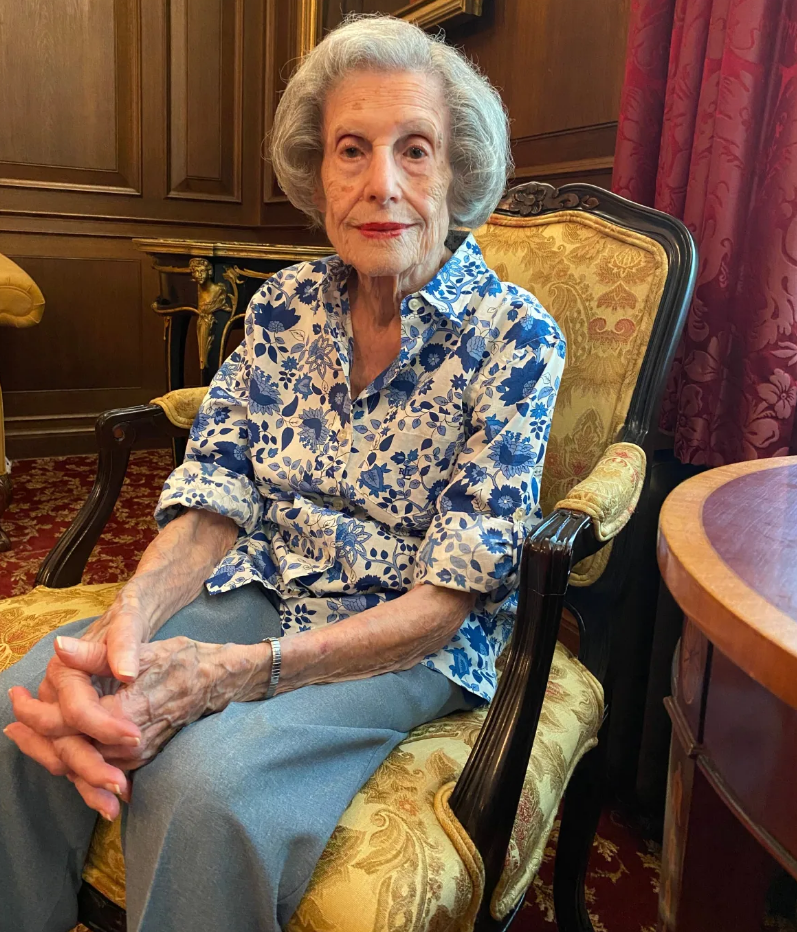
Abelson native Sylvia Hellman worked on the Japanese section on the second floor. A young, ambitious typist and Willis Business College graduate, she recalled typing up decrypted messages, sealing them in envelopes, and dispatching them to the Department of Foreign Affairs. She remembered this period as one of the most fascinating in her life.
One of Sylvia’s colleagues was Herbert Norman, head of the Special Intelligence Unit. Known as a quiet, reserved man, he worked with the unit throughout the 1940s. However, in 1957, an old and baseless accusation of treason resurfaced, leading him to take his own life.
Out of the Shadows
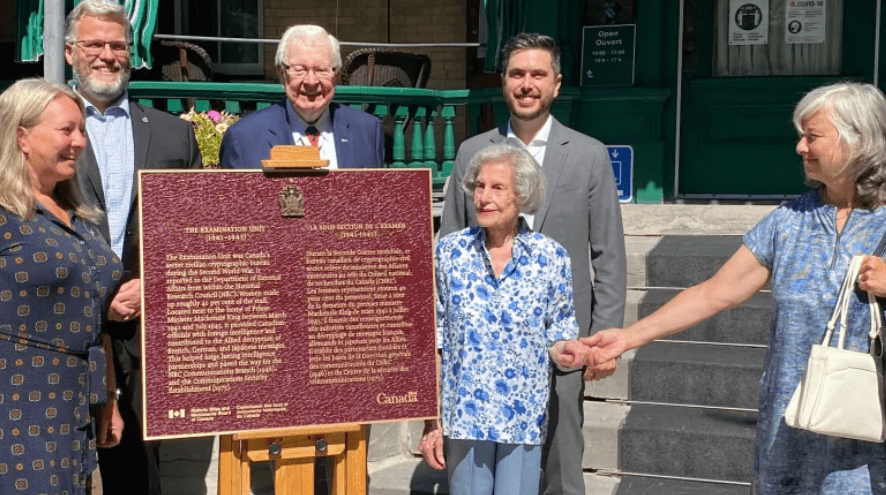
This is indeed the right way to put it. In 2022, Canada’s first code-breaking unit officially came into the public eye. A photograph captured 101-year-old Sylvia Hellman standing beside a commemorative plaque for the Examination Unit, the wartime code-breaking bureau where she had worked during WWII. Her family, friends, and even close acquaintances had no idea what her work involved in the early 1940s. Holding her hand in the photograph is the daughter of her former colleague, Rita Bogu.
The mansion on East Laurier Avenue was a place of secrets and codes, where nothing leaked beyond its walls. Spies undertook a secret mission—breaking codes and ciphers.
The commemorative plaque was installed at Laurier House, a national historic site near Sylvia’s wartime workplace. After the war, Sylvia and her colleagues received strict instructions never to speak of their work, a secrecy mandate they were to honor for life. However, it was finally time to unveil these secrets.